January 4, 2012

Side Effect

In college, I worked in an animal kennel in Illinois that housed both strays and dogs boarding for a time. I didn’t like holding for euthanasia, but I was proud I was strong enough to do it. I was young and stupid. Another worker had more seniority than me and had the opportunity to be supervisor, but she didn’t want to help with euthanasia. After I eventually quit, she did help with euthanasia. Then she quit.

Some states allow use of the gas chamber. In some rural areas, they shoot strays. It all depends on what the state law allows. California has one of the most humane laws on the treatment and impoundment of stray dogs and cats, including the method of euthanasia. Animals are to be injected in the vein of their front leg.

In Illinois, it’s legal to inject the euthobarb serum straight into the animal’s heart, or thereabouts.
           
Getting a heavy-duty needle through a rib cage isn’t painless, by the way.

I, too, eventually had to let the pain in. But not right away. I found myself despising the animals at times, especially the boarders. They were so lucky not to be a stray. I’d stare at them as I moved down the main aisle and they’d know I was pissed. I’d swear if a dog shit in his cage after I cleaned it. They understood they had done something wrong.

One week, I went overboard twice. I placed my Doberman in a cage with another stray and egged them on to fight. When they commenced to fight, I stopped the proceedings instantly apologized to my dog only.

The other time I went overboard with a friendly, cute little Beagle. He was a boarder. I told him what a bad dog he was, cleaned his cage of pee and squeegeed it dry after knocking the squeegee against his legs a couple of times as I reached it to the back of the cage.

I wasn’t done. I emptied his paper water bowl, struck him on the head with it and tossed the empty bowl on top of his head as he cowered in the corner. I told him he was bad, shut the cage door, made sure no one had been watching, and left him there for the night.

I didn’t sleep much thinking about what I had done, what I had become. I loved animals. That’s why I took the job. So why was I acting like a monster?

I arrived early the next morning, went straight to his cage and found him in the exact position I had left him, curled up with a paper water bowl upside down on his head. He peered out from under the rim. I opened the door, snatched away the bowl, filled it with water, pet him, apologized and told him what a good dog he was. I was whimpering. The Beagle allowed me to pet him, though warily.

When I brought the dog to his owner in the lobby that afternoon, the dog was happy to go home. The owner didn’t even look at me or the dog as she paid the bill. Had she, she probably would have seen pure guilt in my eyes.

I wondered if the dog would return. If he did, would he bark, back away from me? The universe provided an answer. A couple weeks later the Beagle and his owner returned. I answered the call that a dog was in the lobby and needed to be brought back to the kennel. The Beagle saw me and followed on his leash without hesitation, even wagging his tail. I couldn’t believe it. I thanked him, and for his stay I treated him like he deserved, like royalty.

I never became angry at a dog or an animal after my experience with the Beagle. I didn’t love them all and cuddle with them all either, but my time intimidating the animals was over. The Beagle was my savior in that way.

Before quitting, I held for less than thirty euthanasias while working at that small animal kennel during college. 

Twenty years later I found myself living in California and volunteering at the Carson Animal Shelter, where more than 7,000 animals are euthanized a year. There are no “cardiac sticks,” or needles piercing hearts, as that method of euthanasia is illegal in California, and that's a good thing.

As a Carson volunteer, I didn’t assist with euthanasia. But I knew from experience that type of work can be difficult spiritually.

I remember a young animal care attendant working in her first week at Carson. She talked about positive energy. She waved her hands over me while I cleaned kennels to share some. I saw her a week later and asked about positive energy. She said there was euthanasia happening in back, and there was no positive energy.

She never talked about positive energy again, and quit soon after.


Pit Bulls are the most common breed of dog at the Carson shelter and the most euthanized. The above photo is the only photo I took at Carson while I was a volunteer. The Big Man was one of several dogs I befriended before they were euthanized.


December 27, 2011

My Boy

Way back when, I entered young adulthood without knowing a whole lot about how to connect deeply with other people, perhaps like many of us. I had my friends from childhood and that was about it. I socialized only when I had to. And I consciously limited those occasions.

In college, I worked at an animal pound and ended up adopting a dog. I had no idea what this would mean.

He wanted to be with me all the time. He loved me no matter what. It was all a new experience for me. I found joy in giving him a good life, and I ended up getting in touch with something inside me I hadn't often experienced since early childhood: The ability to be with another exactly as I was, without fear of judgment.

For someone who never loved a pet this may be hard to understand, but he was the twinkle of my mornings, the blue of my evenings. 

Love can lift that way.

After arriving in California in January 2006, I rented a beach cottage with a large yard for my dog’s last couple months. He had a brain tumor, and when he died, I understood that I was going back to an animal pound to do some work and honor his memory.

This multi-media project I’ve completed is nothing more than my best thank you for all the impossible doors he unlocked within me.

December 19, 2011

Deadline Creature

I used to have one of the greatest jobs ever: A daily newspaper reporter. Mostly I covered local news. I reported on city government, breaking news, features, the police and fire departments, some politics and an occasional document-based investigation. When my father died in 2004, I found myself not producing to the level I had come to expect of myself. My dad was a former journalist and after I went into journalism in my 20s, my father and I instantly developed a special friendship. Reporting and writing stories just wasn't the same without him. So I took a break.

I quit my reporting job in New England and, slowly, moved across the country to Southern California. I figured I'd do some volunteering until I was ready to return to reporting. The newspaper industry and economy went in the tank, however. Standing job offers were no longer available as my contacts had been laid off.

I tore through my savings account, though it lasted longer than I ever could have imagined. More than $120,000 lasted more than five years, during which time I took vacations to Italy and Paris, and took several trips to Portland, Chicago and Cleveland. I mostly lived with friends or family. But I also have had my own apartment as well as lived in a run-down beach motel during a couple off-seasons. Sounds romantic? At times the journey has been. Other times I have struggled. Like everyone.

After my money ran out, I picked up some spot work for AOL, and I continue to be grateful for that.

This year has been a return of sorts. I have learned once again how important producing good journalism is to my self-esteem. I am so lucky that the best non-fiction narrative editor in the country agreed to help me with my story of the Carson Animal Shelter. Working closely with an editor is a gift, especially a great one. Any story gets better under the direction of an experienced editor. It's a painful process, as the editor inevitably makes cuts and says it's not good enough, but such moments are a test for the writer to determine whether the work itself has improved from the changes or not. My story sure has improved from the first stab at a draft. It's not a book. It's a feature story, and I'm still shopping it. If I didn't have to pay the other journalists who helped with the story, I'd probably just run it in my blog.

But everything happens for a reason, and I hope to find a home for it soon.

The deadline for my finished story was last Friday. Since then, I've been putting together photos and captions. The photo above is what it looks like: Two volunteers giving a stray dog a bath. I wanted a photo of the dog shaking and the volunteers ducking out of the way of the spray, but this simple framed photo I ended up liking best.

December 8, 2011

Unclaimed Position


Yesterday we served coffee and oatmeal and hard-boiled eggs while security guards hired by the business association took photos of the homeless in line. They’ve done this regularly since the police and county health inspectors tried chasing the food servers away earlier in the year.

How about the position of the homeless in downtown L.A.: Being photographed in order to receive a free breakfast.

Afterward, my friends and I attended a burial ceremony to commemorate the year’s unclaimed bodies in the city.

There’s a reasonable chance some of those bodies ate food prepared by my friends.


Here's the latest on the breakfast line.

December 1, 2011

The Step-Down Room

The step-down room on the second floor was added to the Victorian in the 1940s. It is the most popular bedroom in the house, with good reason, beginning with the four steps leading from door to floor. 

Sunken rooms are fun, especially in a hippie house where everyone lives in voluntary poverty.

When my friends began occupying the Victorian in 1978, they used the step-down room to put together editions of their radical newspaper. The newspaper’s overflowing archives and parties have since been moved to the basement of the back house, so that the step-down room has passed from occupant to occupant, and I mean couple to couple.

Jim and Joyce lived in the step-down room 20 years ago. Now they live in Long Beach. Jim still enjoys driving up and answering the phone at the house on Saturdays, while everyone works at the soup kitchen.

The ceiling in the step-down room was painted a few years ago by a couple who fell in love after meeting here. After they moved out, Kurt and Sybilla moved in for a year.

Now the step-down room happens to be my girlfriend’s room.

Last night I fell asleep staring at the ceiling and listening to the sound of helicopter blades churning over Occupy L.A. Five members of this community were present at the eviction. Four were arrested.

I’m so grateful there was no serious violence, despite the local newscast repeatedly and unequivocally stating beforehand that 15 to 30 “bad apples” among the protestors were going to become violent with the police and the police will have to respond.

Don’t you just love it when reporters tell you the story before it ever happens.

Of all the garbage the local newscast dished out, my favorite was a demonstrator grabbing the microphone of an on-scene reporter and criticizing the mainstream media for showing images of people with gas masks ready instead of interviewing school teachers planning to be arrested. The station cut away to another reporter on the scene showing protestors with gas masks ready.

This morning, I flew to Cleveland to complete the data analysis for my animal shelter story. I'm really looking forward to sharing it here later this month.

Issues of fairness and justice have been on my mind, and how these sorts of stories are told. I find myself thinking about the future of this world plenty lately. 

But mostly I just like hanging out in the step-down room.


November 26, 2011

Enough Food For All

For Thanksgiving 80 people showed up. Forty were invited. It usually works the other way. Half as many as invited show up.

I washed a total of four plates and spent the afternoon playing croquet on the lawn with our guests.

I don’t get the alone time I’d like to have here in order to write, and this past week was especially challenging with the holiday.

But that’s the world. I’m thankful for a roof over my head and for being able to swing a mallet while the cleanup was done without me.

November 17, 2011

Clothesline

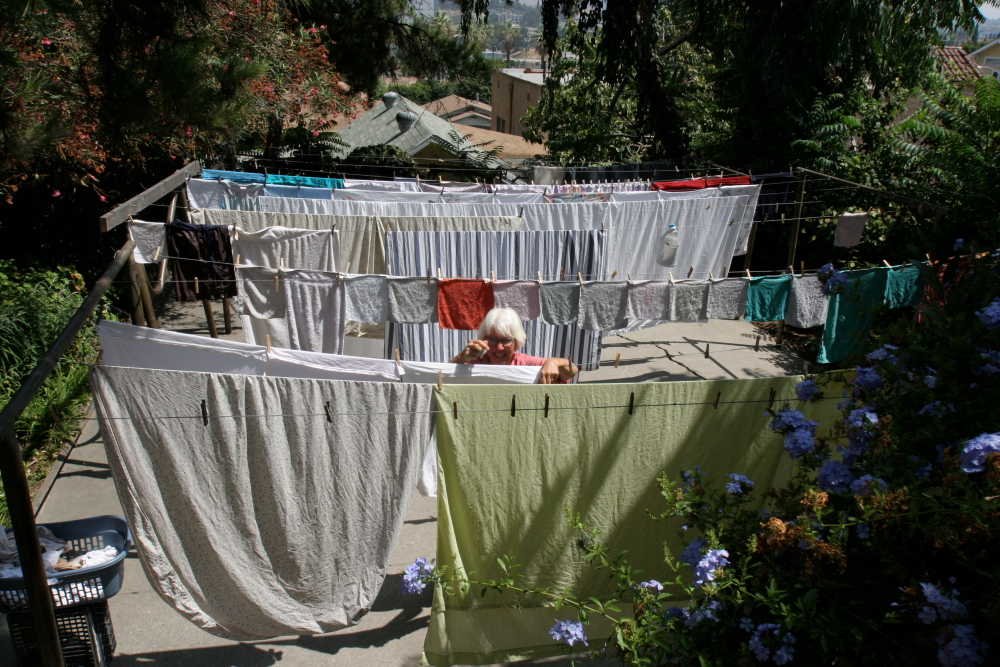
Kids from the neighborhood occasionally crawled up the hill at night and stole jeans off the clothesline. That happened in the 70s and 80s and even 90s, before this neck of East L.A. gentrified. Now many of the kids in the neighborhood wear nicer jeans than the hippies and anarchists who live here, and a pair hasn’t been stolen off the line in years.  

One washing machine spins the load here and no dryer. There is no shortage of clothespins, so long as side-by-side items share a single pin. Dish towels and general cleaning rags from the soup kitchen are washed and hung before personal laundry, which is how it usually works.

Pictured above is Catherine Morris. She has been to jail more than 40 times over the past 40 years in protest of various injustices, from the latest war to the consistent treatment of homeless folks.

So it’s a kick to know these people who have been doing civil disobedience for a long time, especially when we load up the pick up after working a full day in the soup kitchen and head out to feed everybody at Occupy L.A. Today they got ice cream. 


November 7, 2011

Staircase

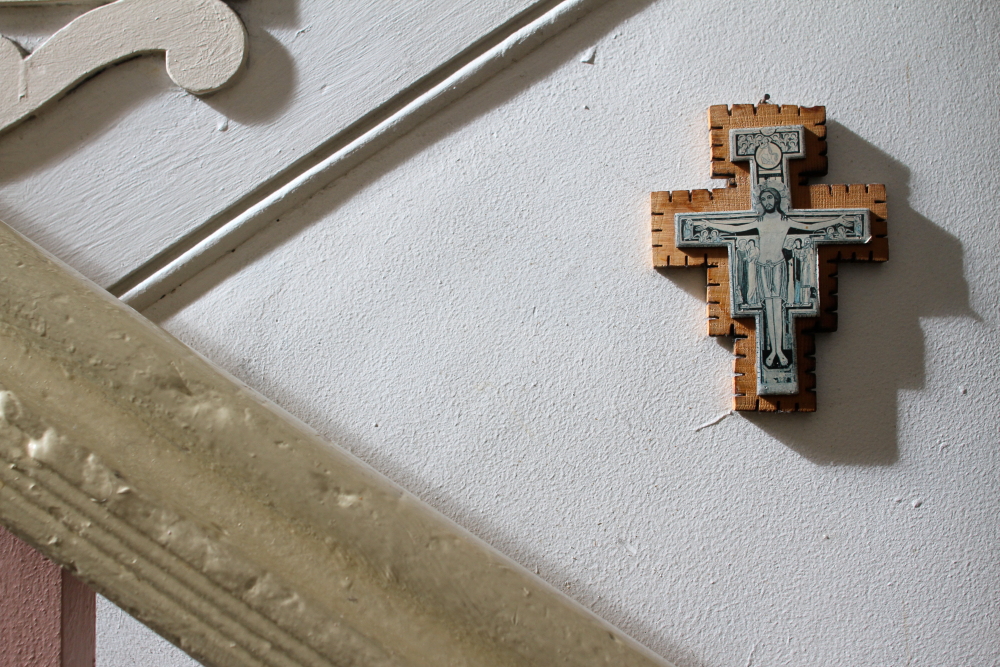
Working and living here and working on my draft of my animal shelter non-fiction narrative has consumed a lot of my fire lately. But I chased some light in the stairwell this afternoon after my nap in the closet and wanted to share. Looking forward to reading blogs this week.
I plan to add a couple more photos of the staircase over the next couple of days. Ten minutes of light wasn't enough to do justice.


November 2, 2011

Yesterday

Got up at six. Had tea and toast. At the soup kitchen, we swept the outside seating area by 7. By 7:20, I was eating a pancake the cook whipped up for the early morning help. I made salad dressing for 1,200 people. I forgot to mix four garlic heads into half the batch, but it all worked out because the cook needed to get the pasta going quick and when he found out what I had left in the blender he was thrilled. While we served food, I tossed tomatoes in the salad and buttered bagels and opened donated bags of pasta, the sample size. 

Got home at 1:15 p.m. The week’s community meeting began at 2. It was noted that an unusually large amount of food was served for the first day of the month, which is when people who live on checks usually receive their checks. They don’t visit soup kitchens until their money runs out later in the month.

I made dinner. It consisted largely of leftovers from an acclaimed Monday meal. I’m lucky that way. On my very first “house day” in 2006 a friend of the community’s dropped off an entire rib dinner for forty. There were twenty in the house at the time, but we put it all away. I accepted credit for the rib dinner as I did the leftover buffet, though little was forthcoming. After dinner, five people performed a Gregorian chant after the cat was removed from the room. The cat knocked over a photo of Cesar Chavez on the top-most tier of the Day of the Dead altar in order to sleep. Luckily, there are many pictures of Cesar in the house. Also lucky that someone snapped a photo before Star was evicted. 

Before I locked up the house at 10 p.m., I forgot to fetch the 10-gallon pots from the garage and fill them with water on the stove so the early risers could fire up the burners for whichever anarchist or hippie happened to be making coffee and oatmeal in the morning. I fell asleep in the closet to thoughts of sugar plums and having the entire afternoon free today to write in my blog.